English
 français
 Deutsch
 русский
 italiano
 español
 português
 Nederlands
 العربية
 日本語
 한국의
 Türkçe
 Tiếng Việt
 slovenský
 Indonesia




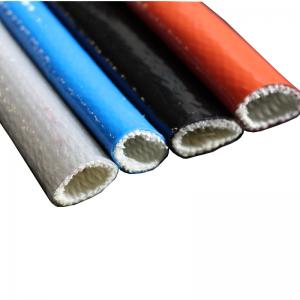
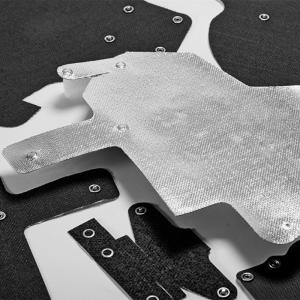
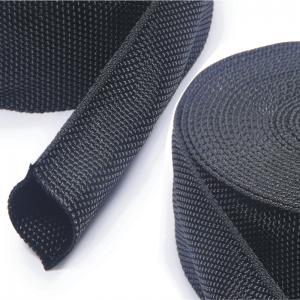
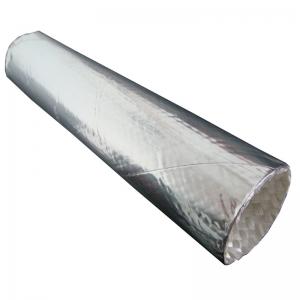
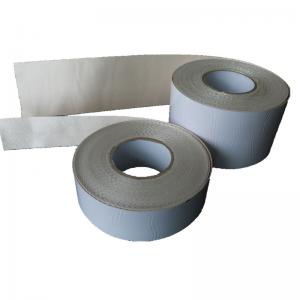
A custom high temperature tape specification should define the material, textile construction, dimensions, thermal duty, installation method and supply format as separate items. A request such as “50 mm heat-resistant tape” is not enough for reliable OEM purchasing because tapes with the same width can use different fibers, weaves, coatings, reinforcements and adhesive systems.
BSTFLEX supplies industrial high temperature tapes for insulation, equipment sealing, cable and hose protection, furnace and oven assemblies, and recurring OEM production. This guide explains how to prepare a repeatable specification for custom tape width, thickness, roll length, coating, backing, packaging and technical approval.
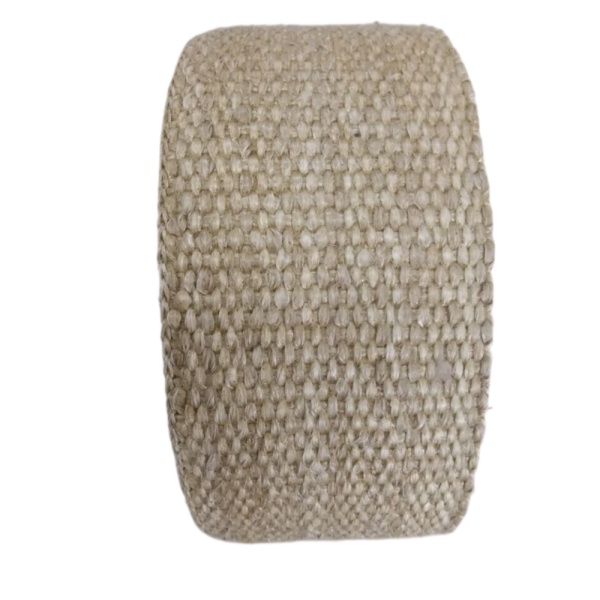
Quick Specification Checklist
Before requesting a quotation, confirm the following:
- the component and function of the tape;
- continuous and short-duration temperatures at the tape location;
- fiber material and textile construction;
- width, thickness and measurement tolerances;
- roll length, cut length or fabricated shape;
- coating, foil facing, reinforcement or PSA requirement;
- installation method and permanent retention;
- quantity, forecast, packaging and labeling;
- required technical documents and sample-approval method.
The most reliable OEM project begins with the application and acceptance criteria, not with a product name copied from an old purchase order.
1. Define What the Tape Must Do
High temperature tapes are used for different functions. The required construction changes according to the job.
| Required Function | Information Needed | Likely Construction Direction |
|---|---|---|
| Pipe or hose wrapping | Outside diameter, coverage length, overlap, heat exposure and fixing method | Plain woven fiberglass, silica, basalt or coated tape |
| Equipment thermal seal | Joint width, installed thickness, compression, movement and leakage requirement | Woven, knitted or other approved sealing tape |
| Bolted furnace or oven joint | Overall width, center opening, bolt diameter, pitch and side-band contact | Drop-warp or ladder tape |
| Radiant heat protection | Heat-source direction, clearance, protected-component limit and fixing | Aluminum-faced fiberglass tape |
| Installation positioning | Substrate, application temperature, required bond duration and permanent retention | PSA-backed textile tape |
| Electrical bundling or overwrapping | Voltage duty, finished thickness, overlap, stretch and environmental exposure | Self-fusing silicone tape, subject to electrical qualification |
Do not combine several different functions into one vague statement. For example, “seal and insulate a pipe” may involve thermal insulation, mechanical retention and pressure containment. A woven thermal tape can address the insulation function but should not be assumed to repair or contain a pressurized line.
2. Select the Fiber Material from the Actual Thermal Duty
The material should be selected using the continuous temperature, peak exposure, duration, atmosphere and required condition after heating.
Fiberglass tape
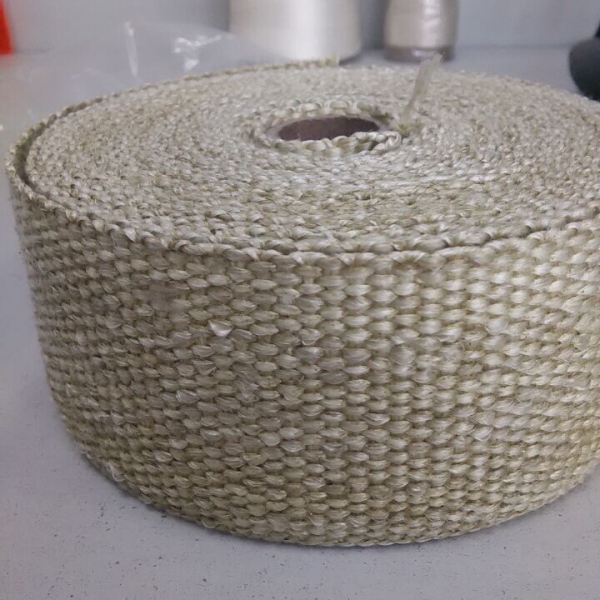
Woven fiberglass insulation tape is widely used for industrial pipe lagging, equipment insulation and general thermal wrapping. It is often the starting point when its confirmed service temperature and mechanical properties meet the application.
Basalt tape
Basalt fiber tape can be evaluated for industrial pipework and equipment insulation where a woven mineral-fiber construction is required. The finished tape's service data, not the raw fiber melting point, should control selection.
Silica tape
Woven silica tape is used where the required thermal duty exceeds the confirmed capability of the selected fiberglass construction. Woven-edge and slit constructions should be identified separately.
Ceramic fiber tape
Ceramic fiber tape is available in reinforced textile constructions for higher-temperature industrial insulation and sealing. The reinforcement material and its hot-strength limit belong in the specification.
Do not select a material only by the highest temperature shown in a catalogue. Compare the exact finished construction, required flexibility, handling, reinforcement, post-exposure condition and technical evidence.
3. Specify the Textile Construction
The same fiber can be supplied in several constructions. Construction affects edge condition, conformability, dimensional stability, fastening and installed behavior.
Plain woven tape
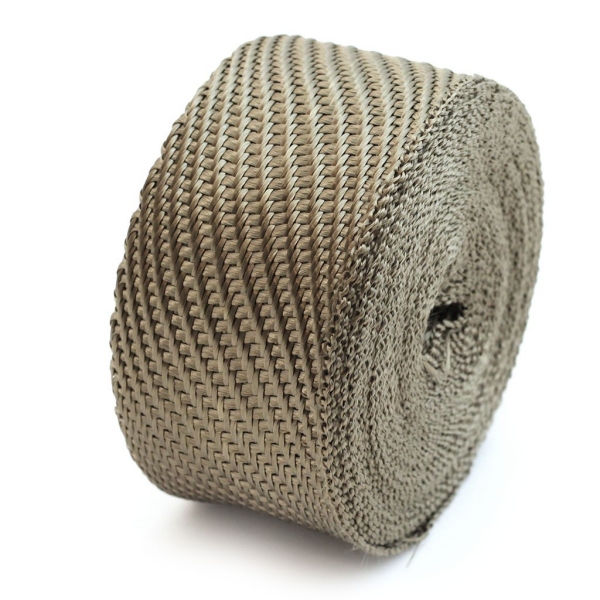
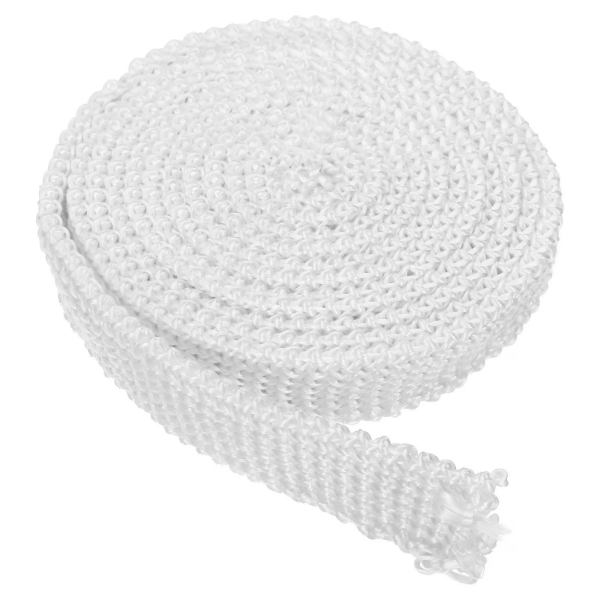
A plain woven tape is a continuous strip with woven longitudinal edges. It is commonly used for wrapping, lagging, flat insulation and selected equipment joints.
Slit tape
A slit tape is cut from wider cloth. It can be suitable where the required backing or supply format is easier to produce from sheet material, but the cut edges should be considered during handling and installation.
Knitted tape
A knitted construction can offer a softer, more conformable strip for selected equipment seals. Specify relaxed dimensions, installed thickness and the required recovery after unloading or heating.
Drop-warp or ladder tape
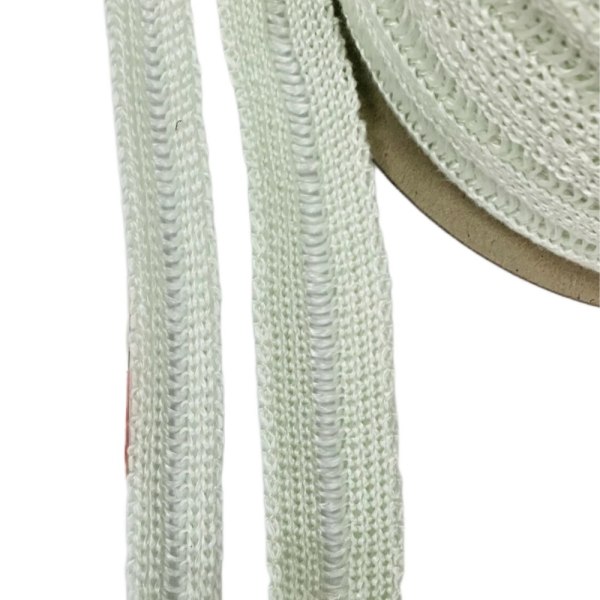
Ladder tape has selected lengthwise yarns omitted from a central zone to accommodate a defined fastener arrangement. The center opening and equipment bolt pitch are separate dimensions.
Self-fusing silicone tape
Self-fusing silicone tape bonds to itself when stretched and overlapped. It is not the same as a woven fiber tape with a silicone coating or a PSA backing.
4. Define Width Correctly
Tape width affects coverage, flexibility, material consumption and installation speed. The widest available tape is not automatically the best choice.
For pipe or hose wrapping, provide:
- the outside diameter at the wrapping surface;
- the smallest bend radius;
- fittings, branches, supports and clearance restrictions;
- the planned overlap;
- the total length requiring coverage.
For a flat seal, provide the seating width and the required position of the tape. For ladder tape, provide overall width, center-opening width and side-band widths.
Width tolerance should be stated where the tape must fit a narrow channel, retainer or production fixture. A nominal 50 mm description does not define the permitted manufacturing variation.
5. Define Thickness and the Measurement Condition
Nominal thickness can be misleading if the measuring method is not known. Soft woven and knitted textiles compress under the measuring instrument.
The specification should clarify whether thickness means:
- as-supplied nominal thickness;
- thickness measured under a defined pressure;
- finished thickness including coating or foil;
- finished thickness including PSA but excluding the removable liner;
- installed thickness under the equipment's closing load.
For equipment seals, installed thickness and closure load are often more useful than an unloaded roll measurement. There is no universal compression percentage for all woven, knitted or ladder tapes.
6. Specify Roll Length, Cut Length and Joining Rules
Roll length affects handling, storage, line changeover, scrap and packaging cost. A distributor may prefer standard rolls, while an OEM assembly line may need cut lengths or application-ready kits.
State:
- required roll length or cut length;
- length tolerance;
- whether joins are permitted within a roll;
- maximum number of joins, if any;
- minimum distance between joins;
- how joins must be marked;
- whether each cut piece requires individual labeling.
Where one piece must run continuously around a door or panel, calculate the developed length from the approved route rather than the external dimensions alone. Include corners, joints and installation allowance.
7. Treat Coatings, Facings and Reinforcements as Separate Options
Additional finishes can change surface behavior, installation and temperature limits.
| Option | Typical Reason for Selection | What Must Be Confirmed |
|---|---|---|
| Silicone coating | Surface protection, handling, selected fluid or splash exposure | Coating formulation, finished thickness and complete-product service temperature |
| Vermiculite coating | Improved high-temperature surface behavior and abrasion resistance | Continuous, peak and direct-flame definitions for the exact construction |
| Aluminum facing | Radiant heat protection | Facing direction, clearance, lamination and mechanical retention |
| Fiberglass reinforcement | Yarn support in selected ceramic textile constructions | Reinforcement-specific service limit |
| Metal-wire reinforcement | Hot mechanical integrity in a suitable construction | Wire alloy, atmosphere, electrical implications and hot-strength requirement |
| Graphite or other treatment | Application-specific surface or handling requirement | Actual treatment, intended function and product-specific evidence |
Do not assume a coating raises the fiber's temperature rating. The coating, reinforcement and finished assembly can each introduce a separate limit.
8. Specify PSA as an Adhesive System, Not a Checkbox
A pressure-sensitive adhesive can help position a tape or provide a qualified service bond. Those are different duties.
For a PSA-backed tape, provide:
- substrate material and surface finish;
- minimum application temperature;
- continuous temperature at the bond line;
- short-duration peak and duration;
- required positioning time or permanent bond duty;
- curvature, vibration and mechanical load;
- oil, moisture, cleaning-agent and chemical exposure;
- release-liner and die-cut requirements.
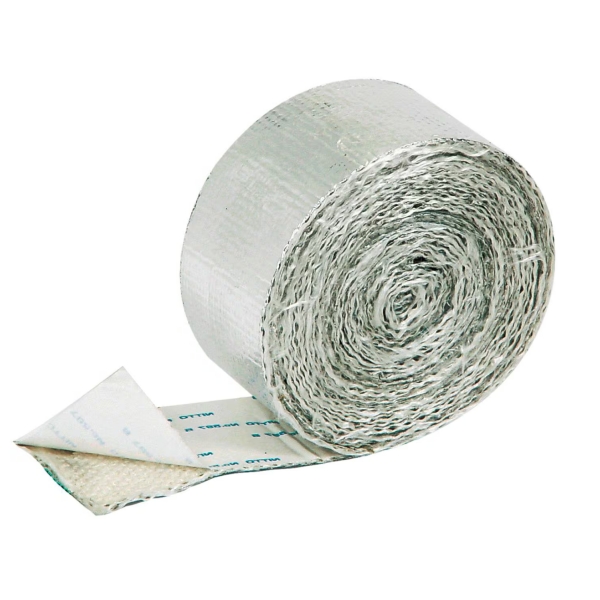
Adhesive-backed silica slit tape and adhesive-backed aluminum fiberglass tape use different textile and surface constructions. Their adhesive systems should not be assumed to have the same temperature capability.
9. Define Core, Winding and Packaging
Packaging can affect whether a technically correct tape runs efficiently through the buyer's process.
For OEM or distributor supply, specify:
- core inside diameter and core material where required;
- winding direction;
- maximum roll outside diameter;
- liner orientation for adhesive-backed tape;
- roll quantity per carton;
- carton weight limit;
- individual bagging or moisture protection;
- labels, barcodes, batch numbers and private-label requirements;
- pallet dimensions and export packing.
Do not request a custom core or automated-unwind format unless the production process actually requires it. Such changes can affect MOQ, tooling, lead time and price.
10. Set Dimensional Tolerances That Match the Application
Overly loose tolerances can produce installation problems. Overly tight tolerances can add cost without improving performance.
Use the assembly to determine which characteristics are critical:
- width for a narrow seat or channel;
- thickness for a closed gap;
- center-opening location for ladder tape;
- cut length for a preformed route;
- adhesive or coating coverage;
- roll length for production planning.
State the test or measurement method where a result depends on load, conditioning or equipment. A tolerance without a measurement condition may not be repeatable between buyer and supplier.
11. Separate Continuous, Peak and Test Temperatures
Every custom high temperature tape RFQ should distinguish:
- continuous service temperature: normal long-term operating condition;
- peak or intermittent temperature: higher short-duration exposure with defined duration and frequency;
- direct-flame exposure: flame contact under a stated test or operating condition;
- raw-material softening or melting point: not a finished-tape continuous rating;
- adhesive temperature: separate from the fiber or facing temperature;
- protected-component temperature: acceptance limit for the hose, cable or equipment underneath.
Do not ask only for “the highest-temperature tape.” A technically suitable product is the one that meets the actual duty with the required mechanical behavior, dimensions and supply consistency.
12. Prepare a Representative Sample Approval
Sample approval should reproduce the intended construction and installation rather than only provide a short piece of textile for visual inspection.
The approval record should identify:
- material and construction;
- width, thickness and roll or cut length;
- coating, facing, reinforcement or PSA;
- installation overlap, stretch, compression or fastener layout;
- temperature and environmental exposure;
- required test methods;
- acceptance results;
- approved sample or drawing revision.
For repeat orders, the purchase specification should refer to the approved construction. A color, width and general product name are not enough to control the material.
13. Request the Right Technical Documents
Documents should match the exact product and intended requirement. Depending on the project, an industrial buyer may request:
- technical data sheet;
- safety data sheet where applicable;
- material composition statement;
- dimensional inspection report;
- batch or lot identification;
- applicable third-party test report;
- RoHS or REACH documentation where required;
- sample approval report;
- packaging and labeling specification.
A company quality certificate does not automatically prove every product-performance claim. Confirm that the requested report applies to the exact tape construction, thickness, coating and manufacturing scope.
14. Build a Complete OEM RFQ
| RFQ Section | Required Information |
|---|---|
| Application | Component, function, industry and installation drawing or photographs |
| Thermal Duty | Continuous temperature, peak, duration, frequency and heat-transfer mode |
| Material | Fiberglass, basalt, silica, ceramic fiber, silicone or proposed alternative |
| Construction | Woven, slit, knitted, ladder/drop-warp, coated, faced, PSA-backed or self-fusing |
| Dimensions | Width, thickness, length, tolerances and measurement conditions |
| Installation | Overlap, compression, stretch, bolts, clips, ties or other retention |
| Environment | Vibration, moisture, oils, chemicals, outdoor exposure and cleaning |
| Supply Format | Rolls, cut lengths, die-cut parts, core, liner, packaging and labels |
| Commercial Requirement | Sample quantity, trial order, annual forecast, MOQ target and delivery schedule |
| Documentation | TDS, SDS, inspection report, test report and compliance documents |
Frequently Asked Questions
Can any high temperature tape be made in a custom width?
Custom width depends on the material, textile construction, loom or slitting method, edge requirement and order quantity. A woven-to-width tape and a slit tape have different manufacturing constraints. Confirm the required edge construction before requesting a custom width.
Does increasing thickness increase the temperature rating?
No. Greater thickness can change insulation build-up, compression and mechanical behavior, but it does not raise the approved service-temperature limit of the fiber, coating or adhesive.
Is PSA backing suitable for the same temperature as the textile?
Not automatically. The adhesive system must have its own application and service-temperature data. In some constructions, PSA is mainly an installation aid.
Can a ladder tape be ordered to match an existing bolt pattern?
The center-opening geometry can be reviewed against the equipment, but the standard drop-warp structure does not automatically create pre-punched holes at a specified pitch. Provide bolt diameter, pitch, end offsets and a drawing.
What is the best roll length for OEM production?
The best roll length depends on line handling, component usage, scrap, roll weight, storage and changeover frequency. Standard rolls may be economical, while custom lengths can improve production efficiency when annual volume supports them.
What information is most important for an initial quotation?
Provide the application, continuous and peak temperatures, required construction, width, thickness, length, quantity and installation method. A drawing, photograph or existing sample improves technical review.
Request Custom High Temperature Tape for OEM Supply
BSTFLEX manufactures industrial tapes in woven, slit, coated, adhesive-backed, aluminum-faced, ladder, knitted and self-fusing constructions. Custom width, thickness, roll length, cut length, color, coating, backing and packaging can be reviewed according to the selected product and order quantity.
Compare materials and structures in the BSTFLEX High Temperature Tapes range.